
Measuring the fundamental psychology of followership
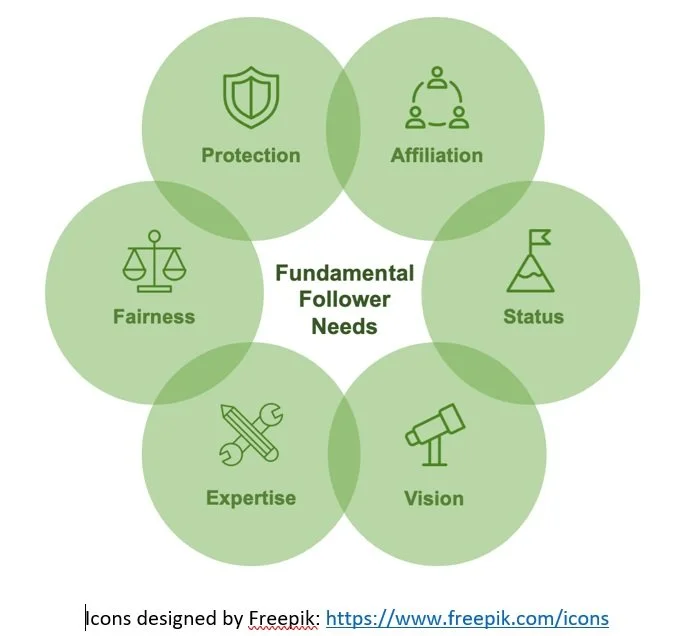
Throughout their evolutionary history, humans recurringly faced situations in which following an effective leader was important for survival. As a result, people today still have an evolved flexible followership psychology that enables them to select different leaders in different situations. For example, people follow very different leaders in war or in peace, when they are part of a tight-knit community or when they live more isolated lives, and when rules for sharing and getting ahead are clear and openly discussed or when they are opaque, discussed behind closed doors, and possibly murky. People in these different contexts are likely to need very different things from their leaders and as a result turn to very different people to meet those needs.
“Not only leadership but also followership is deeply embedded in our psychology. It helped us manage coordination challenges in our evolutionary past and is triggered by their modern-day equivalents”
A previously established framework identified and described three fundamental follower needs: the needs for protection, guidance, and fairness. Building on this original set, this project first created a more complete model of follower needs. A literature search revealed two additional fundamental needs that leaders can meet: status and affiliation. Moreover, guidance turned out to consist of two separable needs: vision and expertise, resulting in a comprehensive set of six fundamental follower needs.
Having identified these six needs, we then developed and carefully validated a scale, the Fundamental Follower Needs Inventory (FFNI), to measure them. We found that the same six follower needs emerged for men and women, for business leaders and political leaders, and across people in the Uk and US and in China. At the same time, we fund some differences in their relatively importance: women had a stronger follower need for affiliation than men and people on average had a stronger need for protection from political leaders than from business leaders. Overall, we found that the FFNI is a powerful tool to measure follower needs in different situations and a strong predictor of people’s leadership ideals.
Find out more
De Waal-Andrews, W., & Van Vugt, M. (2020). The triad model of follower needs: Theory and review. Current Opinion in Psychology, 33, 142-147 Link
Sheng, X., Andrews, W., & Van Vugt, M. (2026). The psychology of following: Conceptualizing and validating the fundamental follower needs inventory. Journal of Applied Psychology, advance online publication. Link
The Fundamental Follower Needs Inventory © 2026 by Xiaotian Sheng, Wendy Andrews & Mark van Vugt is licensed under CC BY-NC-ND 4.0.